Modelling the impact of stormwater management strategies
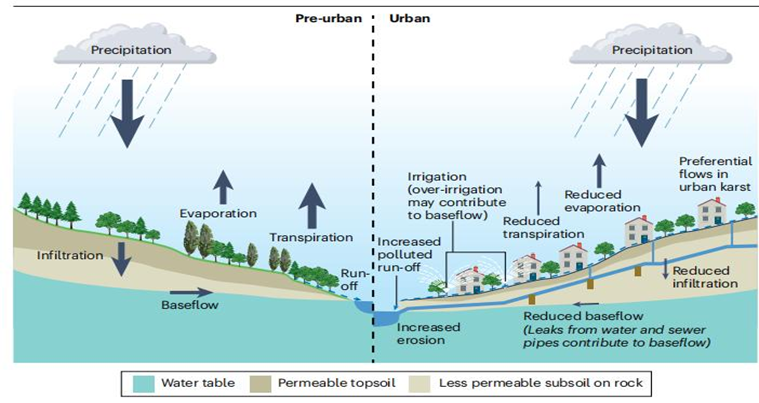
As cities expand and the climate changes, managing stormwater has become a growing challenge. In the western suburbs of Lyon, France, researchers set out to investigate how urbanization and climate change would affect the flow pattern of a peri-urban stream and how green infrastructures could mitigate some undesirable effects.
Using a detailed hydrological model, the team explored how urban development (like covering land with roads and buildings), changes in rainfall patterns (due to climate change), and the use of sustainable urban drainage systems and source control measures such as green roofs, rain gardens, and permeable pavements influence water dynamics at the catchment scale.
Their findings are encouraging but nuanced. Green infrastructures can significantly reduce urban flooding and combined sewer overflows, helping cities to better cope with heavy rains. However, when it comes to the overall flow regime of the stream itself, its impact remains limited, especially under future climate scenarios where droughts and intense precipitations are expected to rise. This is because the stream still receives much of its water from non-urban areas, making it less sensitive to local stormwater management efforts.
The study highlights the value of spatially distributed models in guiding urban planners and water managers. Such tools can estimate how much green infrastructures are needed to fulfil specific management goals and reveal the limits of what “disconnection” strategies alone can achieve.
In short, nature-based solutions strengthen the resilience of urban water systems, but they cannot fully offset the broader effects of climate change. For sustainable water management, they should be part of a larger, integrated strategy that connects urban design, climate adaptation, and the health of local ecosystems.